A famous cartoon character (e.g. Homer Simpson) rendered fully photorealistically as if a…
Full prompt
A famous cartoon character (e.g. Homer Simpson) rendered fully photorealistically as if a real human being, accurately preserving recognizable facial features and proportions
What this tests: Photorealistic portrait style. Tests combining realism (human anatomy, skin textures) while preserving recognizable cartoon features/proportions.
Every model received exactly this prompt and generated a square image at up to 2K. The images were judged side by side; below they are ranked by the judge's 1–10 score, with the written critique for each. Best AI image generator for Ultra Hard →
This offers the strongest balance of recognizable cartoon proportions and believable human presentation in the set. Minor artificial qualities around the eyes and hair prevent a flawless score.
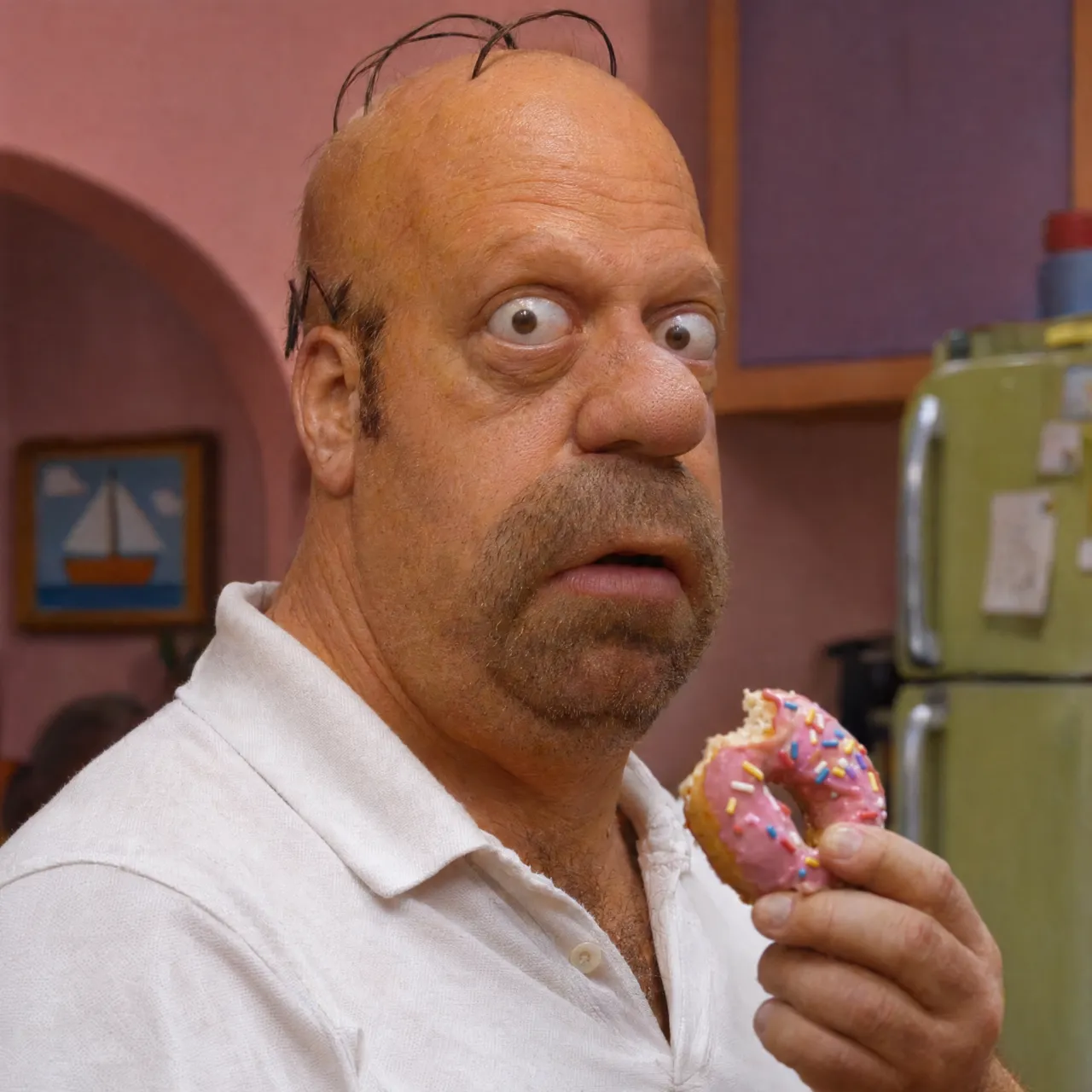
A highly textured human Homer turns toward the viewer while holding a bitten pink doughnut in a colorful kitchen.
This offers the strongest balance of recognizable cartoon proportions and believable human presentation in the set. Minor artificial qualities around the eyes and hair prevent a flawless score.
A heavyset, bald human Homer sits on a brown couch holding a Duff beer can and television remote, with doughnuts nearby.
This is among the strongest genuinely human interpretations, with excellent anatomy and environmental coherence. Its slightly conventional facial geometry prevents it from matching the most distinctive character-preserving portrait.
A bald, stubbled human interpretation of Homer with enlarged eyes, photographed in a kitchen with lavender cabinets.
This is one of the stronger combinations of recognizable cartoon geometry and human surface detail. The conspicuously constructed eye area keeps it below the best-balanced interpretation.
A cheerful, balding, heavyset man in a worn white shirt and loose blue tie sits at a detailed bar, holding a glass of Duff beer.
Its cinematic setting and convincing human surfaces make this a top-tier image. Less faithful facial proportions keep it behind the kitchen and couch interpretations despite its superior environmental artistry.
A balding, overweight man in a white polo and blue trousers holds a pink-frosted doughnut while seated in a worn armchair.
This is a strong naturalistic photograph with convincing anatomy and material detail. Its comparatively generic facial proportions hold it below the interpretations that preserve Homer's identity more precisely.
A balding man in a white shirt sits at a retro diner counter with coffee and a sprinkled doughnut beneath Springfield Diner neon signage.
This succeeds more strongly as an attractive diner photograph than as a faithful cartoon-to-human transformation. Excellent execution is held back by the underdeveloped facial likeness.
A close-up of a balding, stubbled human Homer interpretation with enormous protruding eyes, a rounded nose, sparse cartoonlike hairs, and a white collar.
Ranks third because it preserves unmistakable cartoon features while supplying convincing human skin. The anatomically unconvincing eyes are a substantial limitation and prevent it from joining the two leaders.
A heavyset, balding man in a white polo and blue trousers sits on a sofa holding a red Duff beer can.
Ranks fourth for a convincing human interpretation with a strong Homer-like silhouette. Its generic facial construction limits adherence to the requirement to preserve recognizable cartoon facial features.
A wide-eyed man with receding brown hair and a white polo faces the camera in a warm yellow kitchen.
The image is technically credible, but the character becomes a largely generic receding-haired man. It outperforms the overtly synthetic faces while trailing interpretations that preserve Homer's silhouette and muzzle more convincingly.
A hybrid human-and-cartoon Homer sits frontally on a couch, with exaggerated white eyes, a large belly, and a doughnut in the foreground.
This preserves the character better than several more generic human portraits. Its incomplete transition from cartoon anatomy to living facial anatomy remains a substantial limitation.
A balding, middle-aged man in a white polo and blue trousers sits on a brown sofa in a softly lit living room.
Ranks fifth, offering strong photographic realism but only partial preservation of the character's defining facial structure. That likeness shortfall limits the result despite its accomplished photographic execution.
A yellow-skinned Homer-like figure with gray side hair stands in a warmly lit, realistically furnished living room, wearing a white button-up shirt.
Ranked fifth: excellent staging and environmental realism elevate this above the more obvious figurine renders. It falls slightly behind 4135 because the head is less successfully translated into human form.
An older, stocky man with a yellow-green, heavily wrinkled face smiles in a warmly lit living room, with beer and food behind him.
This is an expressive and attractively lit caricature with strong environmental rendering. The prosthetic-looking face and altered character geometry prevent it from succeeding as a convincing, faithful human Homer.
A close-up hybrid face combining realistic brown eyes, eyebrows, cheek texture, and stubble with a yellow Homer-shaped head, oversized nose, and sharply defined muzzle.
This is the most successful explicit hybrid of realistic human features and the original cartoon geometry. Obvious prosthetic-looking structures prevent full success, but it surpasses the purely figurine-like renderings.
A highly textured yellow 3D Homer appears in three-quarter view wearing a pale turquoise polo, against a softly blurred outdoor background.
Ranks sixth as one of the most accomplished images aesthetically and technically. Its failure to move beyond a textured cartoon model is a major limitation under this particular prompt.
A balding older man with bright yellow skin, a white short-sleeved polo, and blue trousers poses against a plain gray studio background.
This provides a competent live-action approximation with the correct broad visual cues. Weak facial specificity and costume-like skin surfaces keep it below the more convincing photographic interpretations.
A cheerful, balding man with a prominent mustache smiles in a bright living room, with donuts behind him.
The photographic craft is among the best in the set, but the intended cartoon identity has largely disappeared. Because recognizable facial structure is central to the task, excellent realism cannot compensate for that substantial omission.
A balding man with exaggerated round eyes and a white polo stands in a kitchen with wooden cabinets and a refrigerator.
This is a competent domestic portrait whose transformation relies heavily on visibly artificial eyes. Neither the specific cartoon likeness nor the human realism is fully resolved.
A naturalistic close-up of a balding man in a white shirt, with small earrings and a softly blurred kitchen behind him.
This is highly believable as an ordinary portrait but misses the essential requirement of a recognizably preserved cartoon face. That central omission outweighs its otherwise strong photographic execution.
A stocky, balding man with a short graying beard and stained white polo leans toward the camera at a kitchen table with a mug.
Ranks eighth despite strong photographic execution because the character-specific transformation is largely absent. A convincing portrait of an ordinary man does not adequately satisfy the primary subject requirement.
A photorealistic but extremely large-headed balding man sits on a sofa holding a doughnut, with a beer glass, another doughnut, and a sleeping tabby nearby.
Ranks 5th of 11: it is substantially more photographic than the toy-like entries and offers strong environmental storytelling. Severe body scaling and weaker character-specific proportions hold it below the more balanced interpretations.
A three-dimensional Homer figure with yellow textured skin, half-closed eyes, a blue polo, and tan trousers stands against a neutral studio background.
Ranked sixth: this is a competent textured character render with a recognizable expression. It exceeds 628 in overall anatomical integration, but does not fulfill the essential real-human transformation.
A yellow-skinned, balding man with thick eyebrows, a full short beard, and a broad smile wears a white collared shirt in a warmly lit interior.
This is a competent rendered portrait but only a partial success at combining character fidelity with realism. Both the generic bearded likeness and synthetic skin treatment keep it in the middle-to-lower tier.
A highly textured, yellow Homer-like head with enormous protruding eyes and a large muzzle wears a blue shirt and loose red tie.
This improves substantially on the plastic Homer renders in organic surface detail and expression. Its fundamentally nonhuman facial structure still outweighs those strengths for the requested real-person treatment.
A textured, yellow Homer Simpson in a white polo shirt, framed closely in a dark living room with an orange sofa, framed picture, and lamp.
Ranks 7th of 11: the atmospheric setting and added facial variation improve on the simpler CGI portraits. The central requirement of believable human anatomy is still substantially unmet.
A dramatically lit Homer-like bust has pebbled yellow skin, huge white eyes, a densely hairy muzzle, sparse black hair, and a plaid shirt.
Ranked seventh: this has impressive rendering detail but a fundamentally nonhuman facial construction. It sits below 1763 because the texture treatment and anatomy diverge more strongly from a live-action human interpretation.
A tightly framed frontal Homer-like face with textured yellow skin, protruding glossy eyes, dense gray-brown muzzle hair, and a white shirt against a bright yellow background.
This is the strongest of the overtly nonhuman renderings because of its material detail and controlled lighting. Its substantial anatomical stylization nevertheless keeps it below the humanized images and the more convincing human-cartoon hybrid.
A three-quarter bust of Homer Simpson with textured yellow skin, spherical eyes, and gray tailored clothing against a neutral studio background.
Ranks 8th of 11: technically accomplished, but unsuccessful at the defining real-human transformation. Its excellent rendering cannot compensate for retaining almost entirely cartoon anatomy.
A matte yellow 3D Homer-like character with sculpted brown hair and a white collared shirt poses against a dark teal background.
Ranks tenth because it combines a reasonably clean render with substantial departures from both human realism and the character's signature hairstyle. Its orderly execution cannot compensate for missing the central transformation.
An extreme close-up of a glossy, yellow Homer Simpson figure, dramatically lit against a dark, blurred background.
This is a polished and immediately recognizable Homer render. Its fundamental failure to translate the character into a real human substantially outweighs its strong lighting and clarity.
A yellow, three-dimensional Homer-like figure wearing a gray collared shirt and black tie, photographed against a softly blurred, sunlit living room.
This preserves character identity and provides a convincing photographic environment. The central human-transformation requirement remains unmet, placing it below both the humanized portraits and the more richly textured yellow-background rendering.
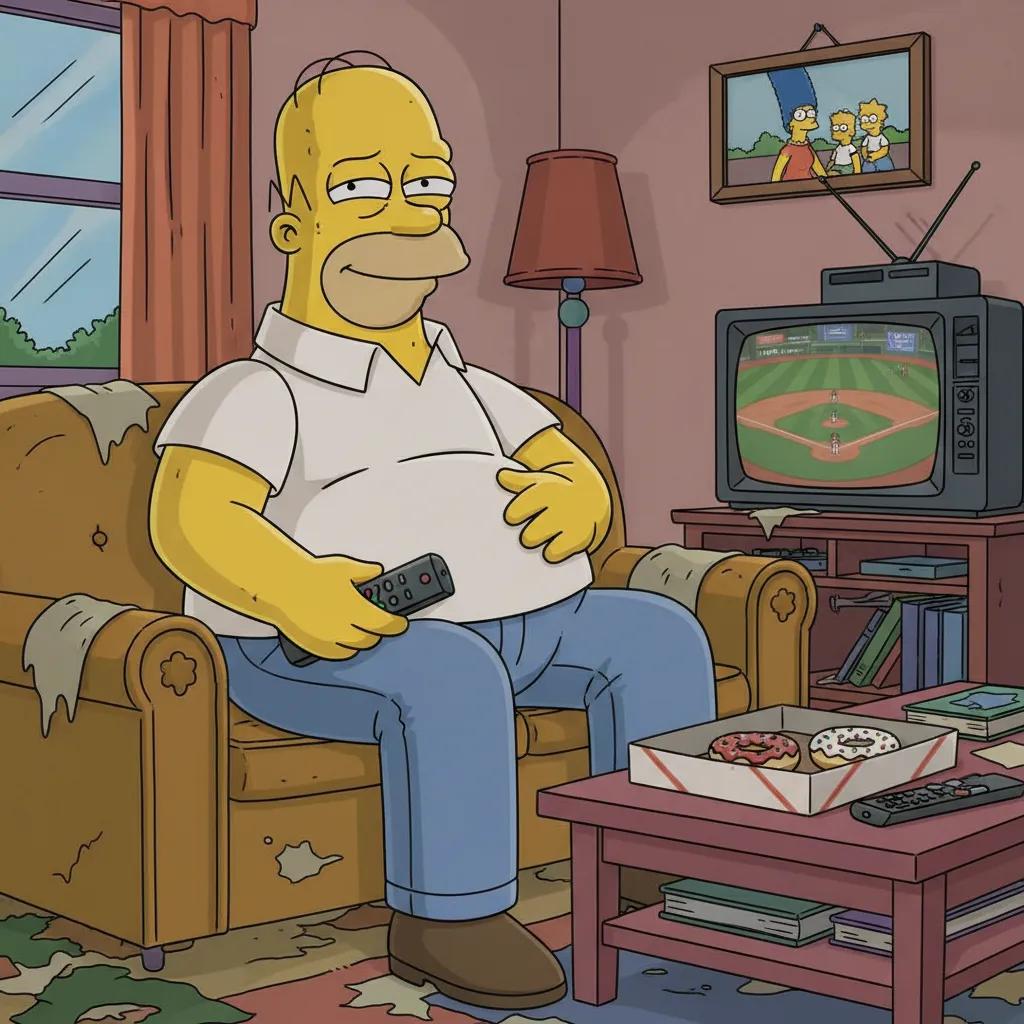
A hand-drawn cartoon Homer sits in a worn armchair holding a remote, with donuts on a coffee table and baseball playing on a television.
Ranked tenth: this succeeds as a cartoon illustration but misses the central transformation requested by the prompt. Its coherent subject and engaging execution keep it above the unrelated duplicated portrait.
A smiling, balding man with a thick mustache wears a white polo in a warm kitchen, with a caption strip below the portrait.
Ranks twelfth because the central requirement of a recognizable cartoon character is not convincingly fulfilled. Strong photographic craftsmanship cannot compensate for losing the requested subject identity.
A smiling, glossy Homer-like figure wearing a blue blazer and white shirt against a dark studio background.
This is the weakest response to the central brief because it remains an overtly plastic cartoon character. Its clean rendering cannot compensate for the missing human transformation.
A symmetrical frontal Homer-like head with pale yellow skin, enormous blue-irised eyes, a smooth tan muzzle, and thick looping hair against a neutral gray background.
This is more portrait-oriented than the full-body toy image, but it remains unmistakably sculptural. The major human-realism shortfall and limited facial detail keep it in the lowest tier.
A full-body, toy-like Homer figure in a white short-sleeved shirt, blue trousers, and gray shoes, standing against a plain gray studio background.
This is the weakest interpretation of the requested human transformation, despite its recognizable character design. Clean construction cannot compensate for the near-total absence of the fundamental photorealistic-human requirement.
A smiling, youthful animated man with styled brown hair, enormous brown eyes, freckles, and a gray T-shirt poses against a gray background.
This is the most off-target result because neither a clear famous-character identity nor a fully photographic human transformation is achieved. Its polished modeling cannot compensate for missing those central requirements.
A full-body, toy-like Homer sits rigidly in an upholstered armchair wearing a blue polo, salmon shorts, white socks, and blue footwear.
Ranks 11th of 11: it is recognizable, but the human transformation is almost entirely absent. The fused hands and uniformly toy-like body are decisive failures for this prompt.
Two nearly mirrored, muscular older men with white beards and round glasses wear white polos and blue trousers against a plain cream background.
Ranked eleventh: this misses both a clearly recognizable cartoon identity and the requested photographic style. Surface polish cannot compensate for those two central failures.